


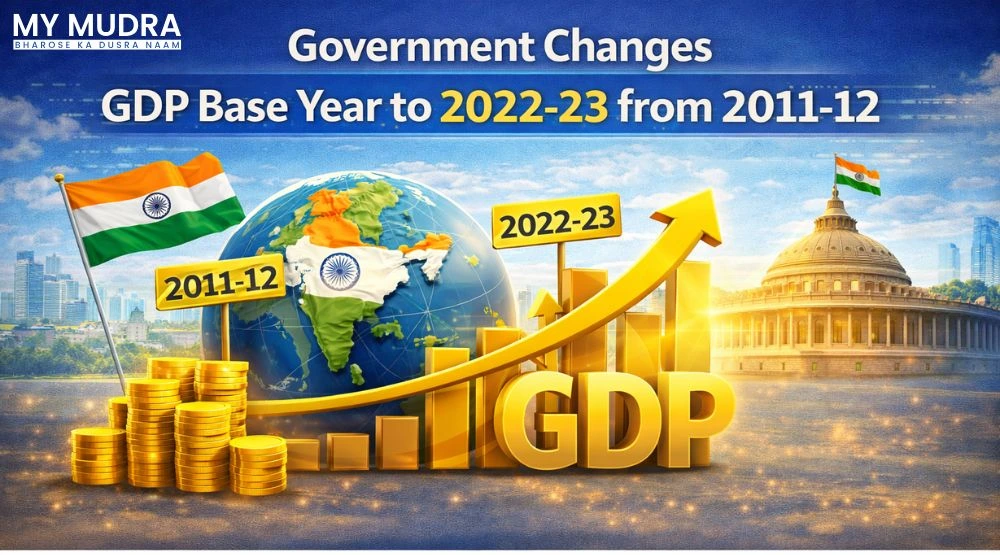
Government Changes GDP Base Year to 2022-23 from 2011-12
The Ministry of Statistics and Programme Implementation (MoSPI) has released the New series of Annual and Quarterly National Accounts Estimates with base year 2011-2012 to 2022 -2023 for Gross Domestic Product (GDP) estimation.
Key Highlights:
- MoSPI has revised the base year for GDP estimates from 2011-12 to 2022-23 to reflect India’s evolving economic structure in a better way.
- New, improved data sources such as ASUSE, PLFS, GST, PFMS, etc have been used in the revised GDP series to strengthen estimation.
- The real annual GDP growth for the financial year 2025-2026 is estimated at 7.6%, while nominal GDP, measured at current price, is projected to grow by 8.6% during the financial year 2025-26.
Importance of GDP
- Gross Domestic Product is the value of final goods and services produced within a country in a specific time period. Nominal GDP is calculated at current market prices, while Real GDP is calculated at a constant base year price.
- GDP is used as an indicator for an economy's size and health, and by tracking consumption, investment, government spending, and net exports over time, one can assess whether an economy is expanding or contracting.
Why is the base year revised periodically?
MoSPI revises the base year periodically to reflect the structural shift in the economy (in digital, start-ups, services, etc), to improve the accuracy of economic estimates, and to incorporate better and more recent data sources (ASUSE, PLFS, GST, PFMS, etc), allowing for more accurate and timely measurement of the sector's performance.
Why is 2022-23 chosen as the base year?
“2022-23 is the most recent “normal” period post-pandemic”. 2019-20 and 2020-21 were heavily distorted due to lockdowns, supply chain disruptions, and abnormal production and consumption patterns. So, 2022-23 was the most stable year.
Key Methodological Improvements
1. Refined Deflation Technique:
- Double deflation technique used for manufacturing and agriculture: In this, separate adjustments are made to input and output prices to measure GVA.
- Single extrapolation technique for others: In this, growth is estimated using a single output indicator.
- The single deflation technique has been discontinued.
2. Supply and use tables have been integrated to align with the National Accounts: This reduces statistical disparities by applying the product balancing principle.
3. Improved estimation of PFCE: A mixed approach of household survey data, administrative record, commodity flow method, and the updated COICOP 2018 has been used to strengthen the estimation of PFCE.
ABBREVIATION
- PFCE: Private Final Consumption Expenditure
- ASUSE: Annual Survey of Unincorporated Sector Enterprises
- PLFS: Periodic Labour Force Survey
- GST: Goods and Services Tax
- PFMS: Public Financial Management System
- COICOP: Classification of Individual Consumption According to Purpose
Sources: PIB, NCERT, drishtiias